Showing posts with label PnPExercise05. Show all posts

Thursday, 18 August 2011

Ancient Eye Placement Principles

In his feedback for my first assignment my tutor noted that it is conventional practise to place the right corner of the eye on the midpoint of the photo. While I agree that this produces a pleasing result I couldn’t help but wonder where this particular ‘rule’ comes from.

Scratching about on the internet produced the following research paper from Christopher Tyler – a visual psychophyicist – whatever that is.

Ancient Eye Placement Principles

The basic conclusion of the paper is that off centring the head so that the artist achieves central eye-placement is a feature classical portraiture over the last two millennia in spite of the fact that eye placement is almost never mentioned in compositional discussion or texts.

The suggestion is then made that there is a subconscious reason for this being the preferred placement, and that other placements are associated with negative qualities in the subject.

I note that Wikipedia refers to the eye-placement theory as controversial and I can certainly see that, from the evidence in the paper, the experimental method might be open to challenge, as might the association with classical Greek and Roman culture (does Japanese or other East Asian art follow the same idea for example?). However the basic idea that we are ‘programmed’ to find some eye placements more pleasing has interesting resonances with the idea of the Golden Mean – even if the maths does not quite align in the two ideas.

Friday, 1 April 2011

Photographing a family party–some reflections in the light of the course material

Was invited to my niece’s 18th birthday party last weekend, and as usual had a great time photographing the celebrations – the output is here on Facebook for anyone who’s signed up. I had hoped to get lots of material for future exercises, but it was not to be. That said, there are a few observations it’s worth recording here.
Lighting
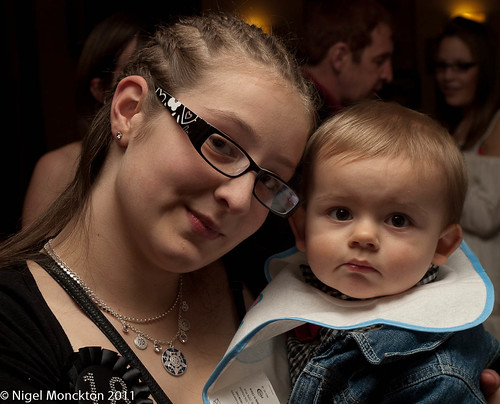
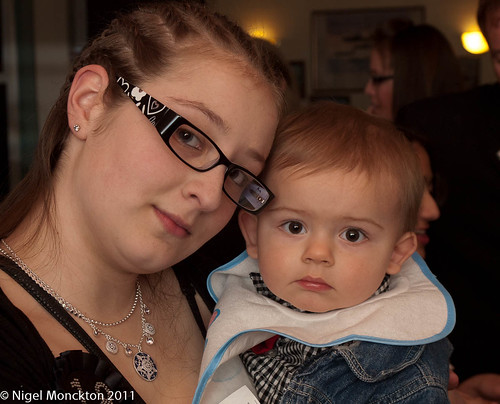
The party was in a small club/bar so lighting was very low, making flash essential. As the place had a low ceiling I chose to bounce the flash straight up. There is a small diffuser built into the flash that pulls out and flips over the light  (it’s intended to help diffuse the light for wide angle shots). If it is not fully extended it protrudes from the top of the flash and helpfully reflects a bit of light forward. This works pretty well, but give the size of the room I was also able, in some areas, to fire the flash backwards over my head, so the subject was lit by reflection from the wall rather than the ceiling. The three different lighting effects can be seen in these photos:
P3264947.jpg
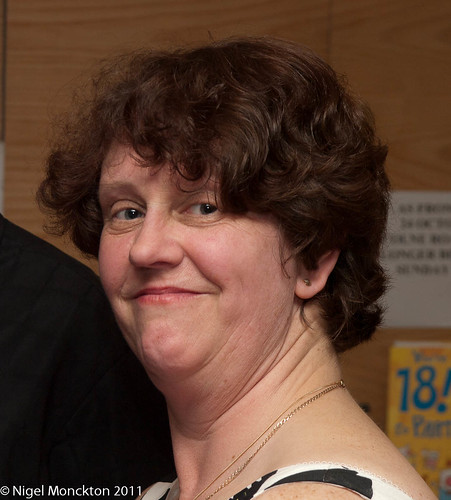
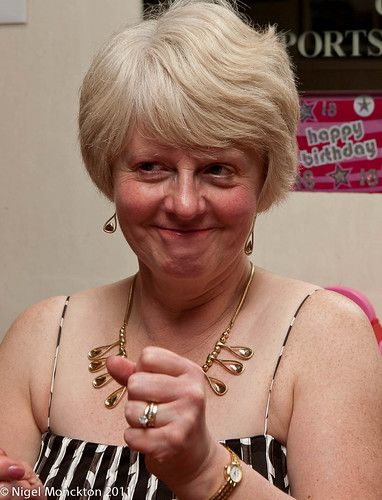
In the shot above the bounced light from the ceiling has given a broad overall light, while the protruding diffuser has reflected some light forward to fill the shadows. Careful inspection of the highlights in my sister-in-laws eyes show both the pool of light on the ceiling and the highlight from the diffuser.
P3264824.jpg
For reasons which elude me I didn’t use the diffuser/bounce in this shot, simply a vertical bounce from the ceiling which has resulted in deep shadows which take the edge off an otherwise pleasing shot. The following result, with flash bounced from the walls is much more pleasing, although it could perhaps be faulted for being a little flat
P3264825.jpg
Eye contact
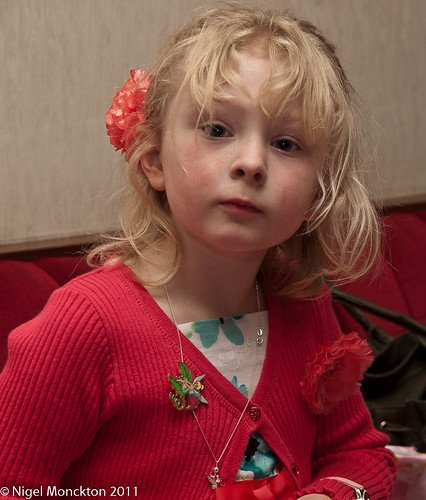
It was a party so people were expecting to be photographed – and even though most of the guests didn’t know me, it was clear that I was with the family. As a result getting eye contact with people was no problem – and given the amount going on it was also easy to get shots without. The two shots of my niece below clearly have very different feels to them, in spite of the fact that they were taken no more than a few seconds apart.
P3264822.jpg P3264823.jpg
Expression and gesture
Similarly expression and hand gesture can change the meaning of a very similar overall pose in a matter of moments.
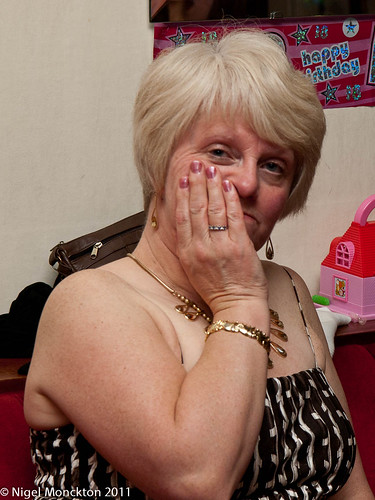
P3264939.jpg  P3264971.jpg
This pair in particular lend some weight to my growing feeling that you can tell essentially nothing about someone from a portrait beyond a rough estimate of age, health and possible social status (based on clothing and jewellery). My wife’s mood did not change significantly between these shots – albeit they were taken 15 minutes apart – and they provide no meaningful insight into her character – I just happened to luck out with the expressions. This is why I struggle with photographs such as Richard Avedon’s The Family which seem to be regarded as providing special insight into the rich and powerful. As far as I can see Avedon’s technique meant he could choose to take a photo that illustrated his particular agenda, and that any chance of objectivity is missing, so the photos probably say more about his agenda than they do the individuals.
I’ll finish on a slightly different tack with a couple of shots of one of my nephews.
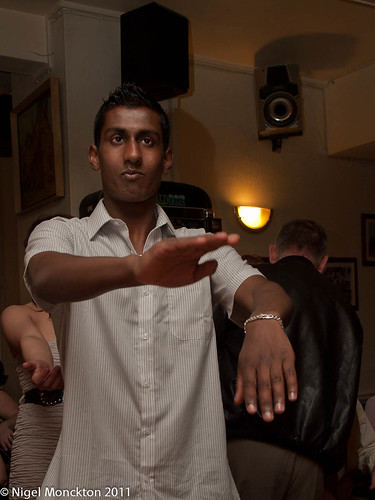
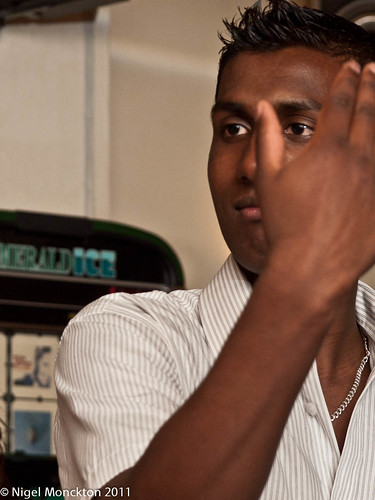
P3264930.jpg   P3264928.jpg
What is happening in the first shot? At first sight it looks like kung fu – the concentrating stare, the odd arm positions, but further investigation shows the arm of the young lady he was dancing with and some loud speakers, so a dance is a more likely outcome – actually it was the Macarena. The second shot is much more intense, and this is emphasised by the way the hand frames one of the eyes. Without the context it is much more difficult to work out what is happening, and I think it is a very effective portrait despite the fact that his hand obscures much of his face.
In summary
Most of the issues raised in this first module were encountered during the evening – even the impact of focal length (I just didn’t keep the odd distortions). Even in near spontaneous photography situations it pays to keep an eye on lighting, and given the vast number of opportunities my advice would be ‘keep pressing the shutter’. Tucked away among the standard shots there will be some really good ones.

Monday, 21 February 2011

PnP Exercise 5: Eye contact and expression

In this link, one of the ways suggested to take ‘stunning’ portraits is to play with eye contact. Eye contact has significance in many cultures – in some eastern cultures direct eye contact with a perceived superior is seen as an aggressive act. In the UK it is rather more context sensitive – it can be seen as particularly intimate, something expected between individuals who trust each other or directly confrontational.

The opposite is also true – in western culture and some eastern cultures averted gaze is seen as a sign of modesty, concealment or simply disinterest – in western business circles avoiding the gaze could even be considered shifty and untrustworthy.

The aim of this exercise is – as far as I can tell – really about exploring these dichotomies. Clearly this can only be achieved in the context of western culture – given that is my background.

I chose my youngest daughter as the subject – largely because she is comfortable in front of the camera, but also because we know each other sufficiently well that there is little need to work on the rapport while using the camera.

First up is a full-on eye into the camera shot – one in glasses and one without

Naomi: PnP Ex 7a                    Naomi: PnP Ex 7a

In the ‘glasses’ shot Naomi is comfortable in front of the camera, and (happily) comfortable with me. There is clear trust between the subject and photographer, and in truth no evidence of aggression or confrontation (again happily). There is an interesting contrast with the other shot where she has removed her glasses. In this example she looks considerably less comfortable and sure.

Looking from the sides of the eye has different impacts depending on the head position and whether or not there is eye contact

Naomi: PnP Ex 7b         Naomi: PnP Ex 7a

For example in the leftmost shot Naomi looks distracted – there is almost a sense of a candid shot to it, whereas in the right hand shot it is clear the subject knows she is being photographed – perhaps even enjoying the attention.

The sense of a candid photo is emphasised even more when the face as well as the eyes are moving away from the camera.

Naomi: PnP Ex 7a

Eye movement in the vertical direction has other meanings. First off a full face with the eyes raised skywards and no eye contact tends to suggest exasperation – perhaps a little exaggerated in this example.

Naomi: PnP Ex 7a

On the other hand, dropping the head but keeping the eyes raised leaves an entirely different impression – one of shyness, perhaps sharing a confidence.

Naomi: PnP Ex 7b          Naomi: PnP Ex 7a

In the right hand shot, the effect is emphasised by the extra tilt to the head and the sideways glance. A raised head gives an entirely different impression.

Naomi: PnP Ex 7a

As a final combination I tried a lowered head and no eye contact. This emphasises the impression of shyness, and instead of a confidence shared we are left with a feeling of a secret concealed, lost in thought in or isolation. In some cultures this could be interpreted as a very submissive pose while in others it could be seen as worthy of sympathy – I tend to the latter.

Naomi: PnP Ex 7b

Interestingly this was my daughters favourite from the set.

A particularly famous example of this kind of pose is Dorothea Lange’s ‘Migrant Mother’ The lowering of the head is less pronounced than my examples but the pose and lack of eye contact demand nothing but sympathy. By contrast Walker Evan’s shot of Allie Mae Burroughs is to my mind much less engaging because of the confident, full on pose and gaze. It is suggested in Angier’s book that this is in part due to Evan’s choice of a long telephoto to take the photo – but I am inclined to think that a different pose would have engendered more sympathy irrespective of the lens used.

Conclusion

To my mind there is clear evidence from this exercise that it is possible to manipulate a viewer into a particular reaction by careful choice of pose, because of the power of eye contact in human culture coupled with the cultural significance of head position.