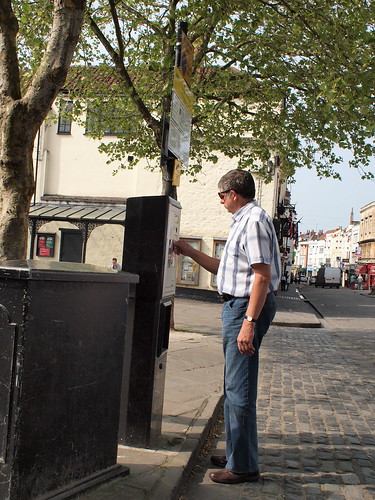
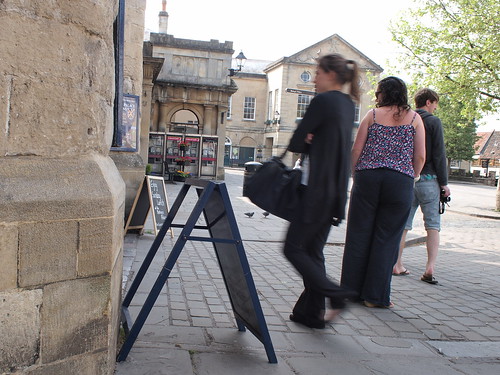
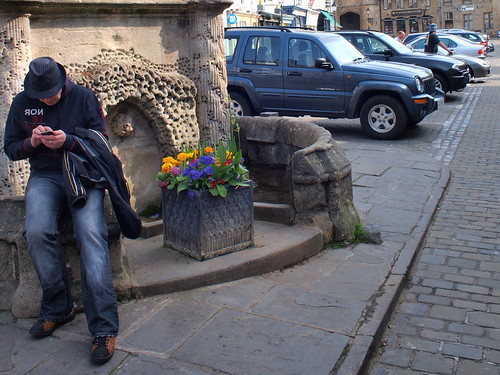
Showing posts with label street photography. Show all posts

Tuesday, 19 June 2012

Loose ends (iii): Just sitting

Another loose end from my list is that on reviewing this blog I found I hadn’t completed Exercise 8:Varying Pose. Continuing with the rather literal and un-creative self-portrait theme I adopted some 18 months ago feels a little like a tick box exercise at this stage, so I felt it would be more instructive to consider some photos I took during the course of this module in the light of my current understanding of the exercise.

I’m going to start with this pair of photos – taken 20 seconds apart – in York during the early stages of the module.

P4105338.jpg  P4105339.jpg

I especially like this pair because they show that relatively small changes in a pose can reveal quite different things. In the first the woman is clearly talking. From the upright posture of her head and the position of her arm it seems likely that she is being quite animated – yet by the simple expedient of leaning slightly forward, moving her arm to her neck and tilting her head to one side she becomes an attentive listener in the second shot (about 20 secs later). This variation in interpretation is achieved without any recourse to her eyes – which remain hidden in both – and is a good example of the power of pose to affect our reaction to a portrait.

This next shot is another example of the importance of head position in interpreting a sitting pose. This pianist, with his arms forward on his instrument and his head tilted to look at the keys is very clearly concentrating on his music and appears oblivious to the little girl watching at the end of his piano. A more raised head position would have suggested a greater awareness of his surroundings, perhaps even suggesting that he was not actually playing at the time of the shot – unlike in this version.

P4105368.jpg

This final shot is of a group of people sitting listening to a brass band concert and I include it here for the variety of seated poses and their impact on our view of the individuals pictured.

E5070303.jpg

The two gentlemen in the centre are sitting in very formal poses, and seem to be taking listening quite seriously – particularly the one on the left who appears to be craning his neck slightly. By contrast the three people on the left hand seat are very clearly relaxed as indicated by the more slouched position and their leg positions as well – indeed the only way the gent on the far left could appear more relaxed would be by putting his hands behind his head. In another take on a simple sitting position the girl on the right is quite upright, but the twist in her body suggests that she is really paying attention to the child in the buggy rather than the band. So, in one shot, in which the subjects are all in essentially the same pose, the slight nuances in limb and body position provide a whole range of clues about activity and intent which we are free to interpret on the basis of our experience.

It is only a short step from here to deliberately using this sort of variation to allow interpretations of a more formal portrait sitting.

Thursday, 29 March 2012

Assignment 4 submitted


An interesting assignment in which I have tried to capture a sense of small town Britain by night. I’ll probably be posting some of the also-rans here later – it was an interesting conundrum trying to decide whether to chose shots I liked or shots which worked well together. Went for the latter in the end as it fitted better with the ‘produce an article’ theme of the assignment- we shall see how it turns out.

If you are interested in the submission you can read it here and see the pictures – including those that didn’t make the final cut – here.

Saturday, 24 March 2012

Ted Forbes on Brassaï on Vimeo

Episode 65 :: Brassaï on Vimeo:

'via Blog this'

A useful if brief insight into the night photography of Brassai. Some useful historical perspective, explaining that this sort of photography was something of a novelty in its time, and that the slow emulsions on the glass plates used in the camera provided some serious technical challenge. Had to chuckle when Mr Forbes mentioned that the photos were 'not perfect' and mentioned their graininess - for me that is part of the attraction.

As one of the tutors has pointed out on the Flickr group, in response to the photo here,  there are some interesting similarities between Brassai and the stuff I'm currently doing.

1000/738: 27 Feb 2012: Co-op Car Park

I'm clearly not Brassai and Maryport isn't Paris, but if I can achieve a similar sense of place and people I shall feel reasonably satisfied.

Wednesday, 7 December 2011

PnP Ex 20: Busy Traffic

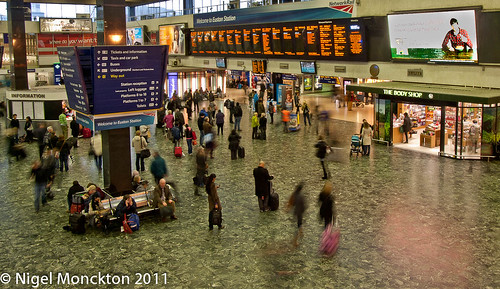
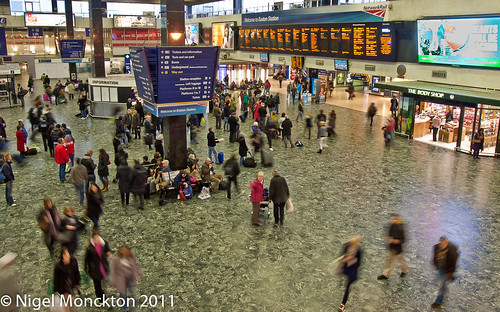
Euston - 4:00 pm  Euston station - 16:01

These first two shots were taken at Euston, right back as I was just starting this course – although they were taken with this exercise in mind. they were shot from the balcony of the ‘pub’ at one end of the concourse. There is a sense of movement caused by the relatively long exposure but overall I think they lack a real sense of business. The likely reasons are:

  • vantage point too distant and elevated – I was not even close to being comfortable shooting people at close quarters at this point in the course and the height emphasises the spaces;
  • insufficient people – an hour later might have been different – but trains times are what they are;
  • the people are too static – tis is down to the location. Most people are standing and waiting for their platform to be announced – a site near the entrance would likely be more effective.

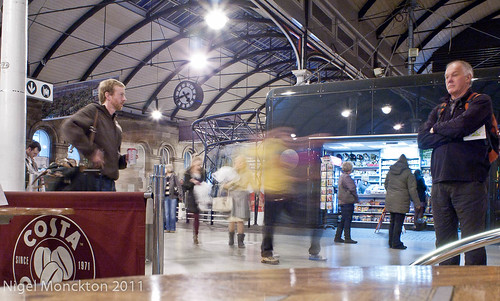
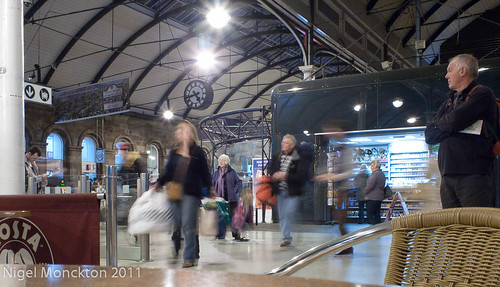
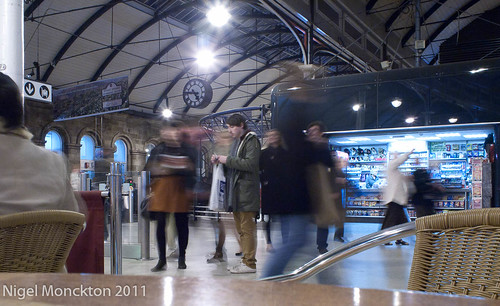
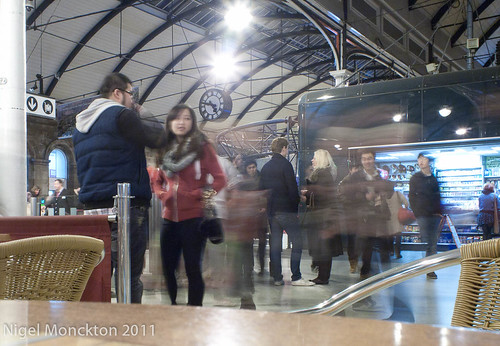
I repeated this exercise a couple of weeks back at Newcastle station after visiting the Turner Prize exhibition at the Baltic, with the following results:

Newcastle Station - 1  Newcastle Station - 2

Newcastle Station - 3  Newcastle Station - 4

These seem to me to be considerably better. There is more of a sense of being amongst the action, the people are sufficiently well defined to emphasise the contrast between the static and moving subjects and I am close to the entrance to the platform so there is actually more movement. I think the second and third are the most effective because they both contain a very static figure to contrast with the bustle around them. The shots were taken by resting the camera on a table in this coffee shop:

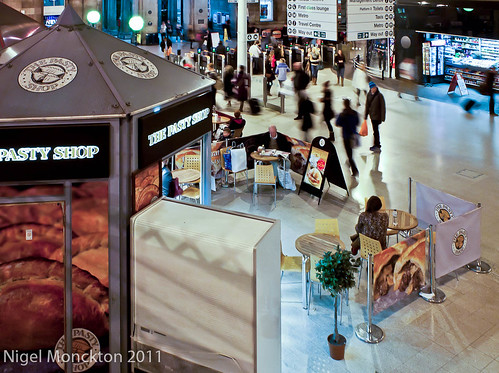
Newcastle Station - 6

This comparison shot immediately shows the effect I noted in the Euston shots – the distance and elevation reduce the overall busy feel.

Conclusion

In the case of crowd scenes at least, motion blur gives a better impression of business when you are in amongst it – or at least quite close. Elevation reduces the effect further by emphasising floor space.

Sunday, 5 June 2011

Exercise 13: A standard view

For this exercise I’ve tried another trip into Keswick – on a rather more pleasant day, and market day at that, so lots of people around. I found this exercise more intimidating than Ex11, largely because you need to get a lot closer to the subject to fill the frame. I have started to get the hang of shooting on the move without making eye contact, although it still feels intrusive and I’ve yet to really get close enough to start frame filling with a head and shoulders. Oddly I had the opposite problem to previous attempts i.e. there were sometimes so many people that I couldn’t keep moving fast enough to feel comfortable.

Early on in the afternoon I also had a little trouble getting shots in focus.  I had the camera set to auto-iso (upper limit 800), f/11 and manual focus at around the hyperfocal distance, so I was a bit baffled until I realised that I had the camera set only to shoot when there was a confirmed focus – which simply blocked some shots - and that I had to be careful not to move the focus ring by accident.

Anyway here are the best of the bunch. They have all been processed with a preset I like in Lightroom – the slightly muted colours, relatively low contrast and key seem to fit the mood better than the unprocessed version.

Keswick 13:1         Keswick 13:2       Keswick 13:3 Keswick 13:4  Keswick 13:5  Keswick 13:6Keswick 13:7

My personal favourites are the first one, because the newspaper headline caught my eye – although a longer focal length would have been better – the two oriental tourists peering into their cameras – a bit blurred but I still like it – and the last one of the family in the park. In this last example I actually heard one of them ask ‘Did he take our photo?’ as I walked by so it was a bit of a confidence boost to find no-one chased after me!

Thoughts

Most of my thoughts have been expressed in the intro paragraphs. the shorter focal length was more intimidating so I didn’t get the portraits that I achieved with the long lens. Had I used the long lens with the traffic density I had today I think I would have suffered from people getting in the way. I think that I might , with practise get to the point where the 17mm(34mm equiv.) on my PEN felt quite natural, but anything wider than that will require a crowd at an attraction. So time to research some locations for Exercise 12.

Monday, 16 May 2011

PnP Exercise 11: Standing Back

Went in to Keswick today to have a go at this exercise. Wasn’t really expecting much luck as it was 16:00 when I got there and a drizzly Sunday afternoon. My rationale for going there at all was to try to make the situation more comfortable – people in Keswick are well used to tourists with cameras shooting everything.

In truth the combination of long lens and less intimidating circumstances worked a treat and I felt very comfortable shooting. I produced about 40 shots in the hour or so I was there, which felt like a reasonable number, given that people were a little thinner on the ground than usual. I had my 50-200 zoom on the E-3  (100-400mm in full frame equivalents) and as suggested in the exercise used it at the longer end as well as the shorter end. The camera was set to ISO 400 to help maintain a reasonable shutter speed in the dull conditions with the aperture mostly at f/4.5.

I pulled the best 8 together for this blog:

PnP11-1

In this one I was attracted by the dog straining at the leash, and the women in the shop watching its antics. Focal length 76mm/152mm equiv. The longer focal length, and the fact that there attention was distracted meant they were unaware I was taking this shot.

PnP11 - 2

This shot, at 200mm/400mm equiv. would have been unavailable without the telephoto – there was a hedge in the way, and even without it by the time I had got closer the shot would have been gone. This is the kind of thing the British seem to excel at – going on a weekend break to play pitch and putt in the rain.

PnP11 - 3

I thought the reflection offered some potential in this shot – not quite sure that it works but thought I’d include it here as an example of an experiment with reflections. (88mm/176mm equiv.) In truth I could have done this with a variety of lenses.

PnP11 - 4

Without the long lens I’d almost certainly have lost this opportunity – simply through not wishing to intrude too closely. It’s quite a nice shot, although had I been a bit quicker I’d have caught them adjusting each others hoods so their faces would have been visible. (137mm/274mm equiv.) This seems to be a forte of the telephoto for street shooting – when there are relatively few people about it gives you greater reach, if you can spot the opportunities.

PnP11 - 5

I should perhaps have included this for Exercise 10 – Gesture and Moment. I missed the exposure at my first attempt (quick glimpse at the blinkies on my screen told the story) and grabbed this second shot within a few seconds. This is a much better composition – the legs and arms are synchronised and the heads and the candy-floss line up nicely (158mm/316mm equiv.)

PnP11 - 6

This one was too good to miss – love the colour scheme and the fact that her head is invisible. (117mm/234mm equiv). I could have managed this one with a much shorter lens  as she maintained this position all the way down the road past me.

PnP11 - 7

I took several successful portraits at this cafe as I wandered up and down, generally with the lens more or less at full stretch to improve framing. I’m pretty sure this lady twigged that I was photographing her – although I was a good distance away. (183mm/365mm equiv.)

PnP11 - 8

I’m going to finish with a shot that’s not about people. This would certainly be un-obtainable without a longish telephoto, and reducing the aperture has enabled me isolate the subject more effectively. It would be less of a shot without the people in the background, but the blur helps direct the attention to the true subject. (200mm/400mm equiv.)

Conclusions

I certainly shot more freely with the comfort blanket of distance/relative anonymity, and the camera friendly surroundings. In spite of the relatively large size of the camera and zoom I never felt I was attracting attention.

Other advantages of a longer lens include the ability to reach shots that would otherwise have passed – such as the golfers and the two friends – and the ability to isolate the subject with depth of field. Set against this is a sense of being an observer, rather than being involved and a number of practical difficulties. These include the need to maintain a high shutter speed to reduce camera shake – I lost a few potentially good shots this way – and the tendency for people to pass in front of the lens at key moments. This latter would be particularly troublesome on a busier day.

Follow-up

I’ll have to try this long lens approach in Carlisle – which is busier and less touristy – and see if I have the same results.

Sunday, 8 May 2011

A second attempt at Exercise 9

Went into Carlisle today with the intent (apart from getting new tyres) of nailing Exercise 9, but it clearly isn’t going to be that simple.

The biggest problems seem to be (for me anyway) – closeness and interest. I’m guessing that I’ll get used to the former, it’s just a case of practise and developing some confidence, and maybe the latter will improve with time. But, and it’s a big but, I can’t avoid the feeling that large numbers of people wandering around shopping offers little of interest to me – I don’t particularly like doing it myself, and photographing other people doing it runs a close second to watching paint dry. This may explain why I don’t press the shutter often enough. Perhaps the answer lies in the name of the exercise – a comfortable situation.

Anyhow, I did come back with some shots that I’m prepared to show, the first two of which I felt worked better in B&W using a preset I found here. (On a related note – the source says it’s supposed to replicate the look of Japanese photographer Daido Moriyama – I’ll be looking him up later)

The first I liked because of the position of the ‘To Let’ sign:

To let

and the second because of the irresistibly grumpy look on the old chaps face.

E5070289.jpg

The next two seem to work better in colour – in the first I simply like the bright colour, and alignment of the arm with the heads appearing further down the street, the second speaks for itself – it’s quite a heavy crop because I saw what was happening and didn’t have time to get closer.

E5070290.jpg

E5070306.jpg

Conclusions

I think I opened with the conclusions from todays shoot – this isn’t as easy as it seems. It seems to me that it would be easy to get hung up on this exercise and not move forward. To avoid this I’m going to keep revisiting it while I progress with other parts of the course.

Thursday, 28 April 2011

On Street Photography

A couple of web resources on street photography. The Photo.net link in particular has a long and fascinating set of comments providing a lot of different perspectives on what is, and isn't, street photography. These range from the 'almost anything goes' school of thought to the purist 'it has to be grainy black and white with a rangefinder or it's not street' approach.

On Street Photography
Street Photography guide from Photo.net
Street Photography Now Project

Monday, 25 April 2011

First steps in street photography

I am one of the many who find the idea of taking photos of complete strangers who have not given explicit consent quite daunting. I have managed to convince myself – rightly or wrongly – that part of the problem is the very intimidating and obvious nature of a large black d-SLR, and treated myself to an Olympus PEN E-P1 with a 17mm lens (34mm equivalent). So that’s my technical excuse dealt with.

Before I have a proper stab at Exercise 9 I thought I’d take the camera out and get a feel for what street photography involves. I’d already picked up a couple of tips from various websites and blogs so the camera was set to manual focus at about 10 feet to reduce the shutter lag and f/8 to get reasonable depth of field.

A couple of things became quite quickly apparent:

  • with a 17mm lens you have to get very close to fill the frame with a subject. I knew this but had not really considered the implications for street photos;
  • a fairly quiet morning in Wells is not packed full of opportunities, nor is it easy to be inconspicuous in scarcely populated streets;
  • the camera noise is less conspicuous than I expected, particularly if there is any traffic or other noise,
  • shooting from the hip is pretty hit and miss – even shooting with the camera hanging round my neck is pretty vague;
  • the optional hot-shoe viewfinder is considerably easier to use than the screen on the back; and,
  • for a beginner it feels easier to sit in one place and wait for opportunities rather go hunting.

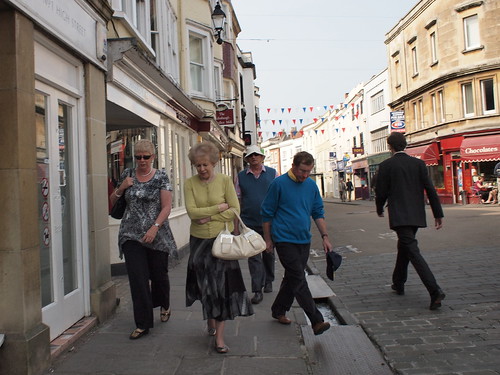
I did manage a few photos that I’m prepared to share, although I make no great claims for their quality. Of the four below I had to crop a couple quite heavily to compensate for the small size of the subject.

Wells1

Wells2

Wells3

Wells4

Sunday, 2 January 2011

Shooting Portraits of Strangers | Shooting Strangers in Orchard Road

This is an interesting project. I’m at the same place as he describes himself at the beginning – don’t quite have the nerve to approach complete strangers to ask for their photographs. I’ll get there in the end. Not sure about his ‘No smile’ approach - I think I understand why he’s done it that way, but it seems to me that asking people not to smile for the camera simply adds a different layer of artificiality to the one that comes from our conditioned reaction to smile for the camera.

Shooting Portraits of Strangers | Shooting Strangers in Orchard Road