This first assignment requires 5-7 different portraits of a single individual. I’ve chosen myself as a subject because I find the idea of self-portraiture quite intriguing. There’s an interesting introduction to self-portraiture in traditional art here which notes that:
“…artists have modelled for themselves in their own works of art. Whether it is an in-depth exploration of the artist’s own psyche or simply because as a model, the artist is clearly the cheapest and most available.”
There are elements of both of these positions in my reasons for choosing self-portraiture. I travel a lot, and have only a small circle of easily accessible friends so self-portraiture certainly makes it more straightforward to progress.
I also think that self portraiture makes it easier to explore the meaning/purpose of portrait photography – assuming that this actually goes beyond making a nice picture. In particular it removes one of the variables from the subject-photographer-viewer equation – reducing it to subject-viewer. It’s reasonable to assume in self-portraiture that the agenda of the subject and the photographer are the same. Whether this makes for a more objective or insightful photograph is a moot point but if it does anything it should reinforce the image the photographer/subject is trying to portray. If done successfully the viewer should then be left with a clearer view of the manner in which the subject wishes to portray themselves.
The final reason for choosing myself as a subject is that it allows me to play with the end result more freely – I don’t have to risk offending anyone.
The photos
The seven photos I’ve chosen can be roughly split into two groups – traditional portraits and some experimental shots. One of the challenges I had in choosing the shots was that I wanted to provide a progression from standard portraits to something more unusual or interesting. They were all (bar the last two) composed using live view on the flip out screen of my camera.
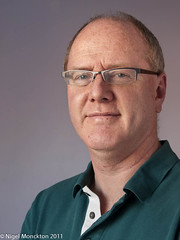
First up then is a very standard casual portrait:
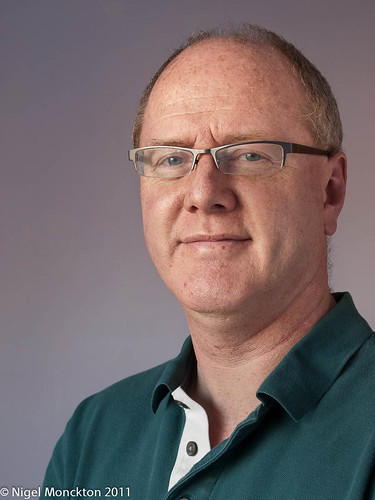
The basic details are f/5.6; 1/15sec; ISO 200; 31mm (62mm equivalent FOV). The light was diffused skylight coming from the left through a large window. The background was a plain bedroom wall. I used a white sheet on the right to lighten the shadows and also held a white reflector out of shot at stomach level to add some extra light under my chin. The camera was fired using a remote control with a 2 sec delay to give me a chance to move it out of shot.
Overall this is pleasing but unremarkable – not dissimilar to the shots the kids have brought home from school over the years. The 2-second delay means that my expression is always a bit of a surprise as the live view disengages during shooting. As a result I needed to take about a dozen shots before I got an expression that feels and looks natural to me – the delay was just long enough that the smile became too cheesy or I lost it and simply looked stern.
As a portrait it reveals a modest amount about me – I’m clearly male, slightly overweight and middle aged. The clothing suggests I’m fairly conventional. I would like to think that the facial expression suggests a relatively easy going nature and that I might find the process vaguely amusing– I certainly did not intend anything more than this – indeed it’s why I chose this particular shot – it’s pretty much how I would choose to portray myself. The pose itself also supports this – if my body had been square to the camera the shot would have looked more confrontational.
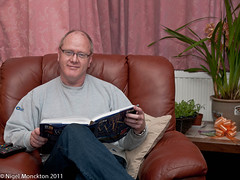
For the next shot I have chosen to pull back to a much broader view with considerably more context:
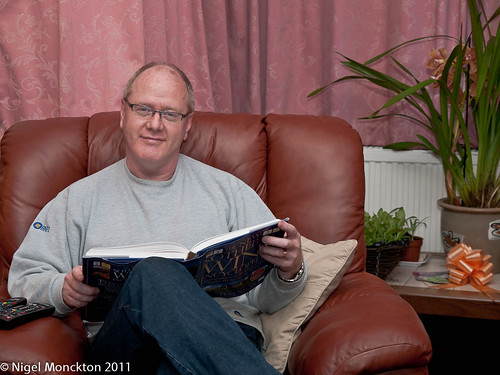
The basic details are f/4; On-camera flash; ISO 200; 43mm (86 mm equivalent FOV). The flash was pointed vertically at the ceiling of a fairly large living room which has resulted in lighting that could perhaps be criticised for being a bit flat but is overall relatively pleasing. The camera was again fired using a remote control with a 2 sec delay to give me a chance to move it out of shot.
The first couple of shots I tried in this setting used a small laptop as a prop rather than the book – I had hoped that the light from the screen would provide some helpful fill under my chin. However it was not really bright enough to be helpful, and it produced a relatively featureless and ugly rectangle on my knee. I tried a couple of poses without my legs crossed but all that did was emphasise how ‘slightly’ overweight I am. I also tried a couple of shots with my head/eyes directed at the book, but they were less engaging than this final version. In particular this feels like a candid shot – I’ve just looked up from a book, and the pose is quite open because the book forces my arms apart, and the disparate height of the shoulders adds to the relaxed feel.
The shot was composed using the standard rule of thirds to direct attention towards my face – the angles of my shoulders help in this respect. There is much more contextual information than the first shot – there is a hint of my personal interests (unless of course I’m simply posing), and a wedding ring perhaps reveals my marital status. There is also a large bow on the coffee table…is it someone’s birthday perhaps?.
By way of a contrast the third shot is much closer in, and in some ways considerably more intimate:
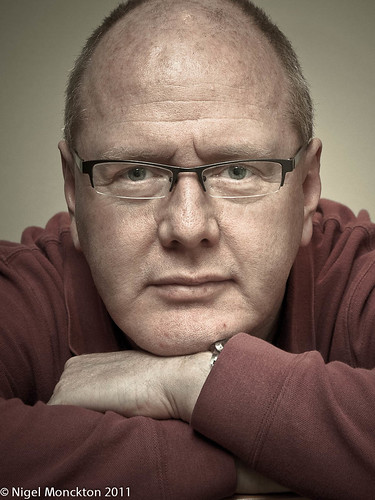
The basic details are f/5.6; On-camera flash; ISO 400; 54mm (108mm equivalent FOV). The flash was again pointed vertically at the ceiling – this time in a relatively small hotel room – so the camera was considerably closer to me. As a result there are noticeably stronger shadows in this shot than the previous one. In spite of the closer camera position and the longer focal length I also cropped in rather more tightly to produce this shot. It is also quite heavily processed. I used a preset downloaded from the internet as a starting point to get the desaturated and warm toned look of the shot. I then did quite a lot of dodging in Lightroom to darken highlights on my forehead and along the bridge of my nose and the top of my wrists.
It was one of a series of shots in a variety of poses – and was one of the few I was really satisfied with. Particular problems included my arm positions looking unnatural, odd facial expressions and unpleasant shadows. I tried to overcome the latter by using a reflector in my lap (or closer still to my face) whenever possible to provide a form of clam-shell lighting. In the end I rejected these and settled for this one.
The direct stare and relatively sombre expression (which sits well with the toning of the shot in my view) give me a rather contemplative feel – worried perhaps? The crossed arms – a classic defensive pose – also serve to suggest some thought processes that I’m unwilling to share. When you compare this with the first shot it’s this sort of contrast which makes me wonder what, if anything, we can really learn about a person’s character from a single portrait.
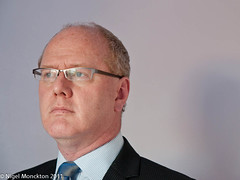
Another change of flavour for the fourth shot. Again a relatively standard portrait – and in the same setting as the first shot, but this time I have tried for a corporate or PR feel to the shot.
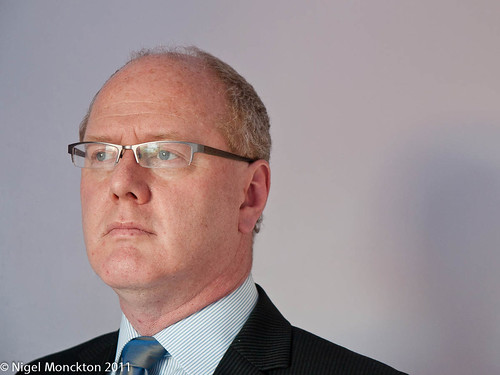
The basic details are f/3.4; 1/10sec; ISO 200; 46mm (92mm equivalent FOV). The lighting set-up was also as for the first shot, except I am rather closer to the background so my shadow is visible to my right.
Again this is one of a series – another example is posted over on my photo-a-day blog. The challenge I found in this series was getting an expression which conveyed the feel of being dressed for business – not too smiley, not too serious. the example on my other blog falls into the latter category. It is far too serious, stern even, to properly represent me.
In composing the shot here I deliberately chose to place myself to one side of the shot – I’ve seen this approach in lots of corporate imagery. To my mind it has an air of abstraction – the subject doesn’t really have time to be there and his mind is elsewhere – the slight upward tilt of the head adds to this. Reading the photo in the traditional L to R manner takes us into empty space – the subject is already off doing other things, and all we're left with is a shadow.
Its instructive to compare this with the same image flipped horizontally:

In this version we still have the abstraction, and perhaps thoughts on the future but the fact the the subject is pointing more conventionally to the right gives a feel that he is marching out of the picture to resolve a problem. In the first example the subject has never really been with us, in this second example, he’s been here, but he really needs to be somewhere else.
It’s also worth noting that, in spite of the formality of the shot, and the clear business feel, in reality I was wearing jeans and the shirt was not tucked in – a full length shot would have been very, very different. Because this is a self-portrait I have been able to choose not only the mask I’m wearing, but the manner in which I portray it. Interestingly though, I felt the need to use a shirt which required cuff-links to help set the mood in my own mind.
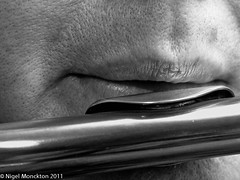
Until now the shots have been fairly conventional portraits, even if simple changes to scale, pose and props have produced quite different styles of image. The next example is very close-up.
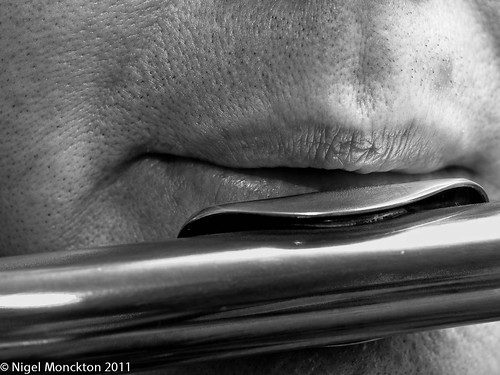
The shooting details are: f/5.6; On-camera flash; ISO 400; 50mm (100mm equivalent FOV). As previously I have used bounced flash, and in this example I have cropped in and straightened the photo to concentrate more fully on the lips. I chose to convert the shot to black and white to manage some troublesome coloured reflections in the flute and the increased the contrast to produce a little more drama. Composition at this scale was quite challenging and I rejected a number of shots with slightly wider views of my face.
Given the very small amount of context, a surprising amount of information can be surmised. Obviously (unless I am deliberately misleading the viewer) the subject has an interest in music, is male and not young (from the skin texture). There is little emotional content, although there is perhaps a hint of sadness because of the similarity between the mouth shape and a sigh.
I’m not sure in my own mind whether the specular highlights are too large but they will almost inevitably be a challenge on a curved reflective object.
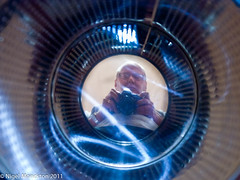
Becoming a bit more experimental, I wanted a mirror shot that showed me holding the camera. I have taken several of these in recent months as part of my photo-a-day project, but used very few of them as they always seem a little dull and false. However, this one is rather different. I took it at about the same time as I applied for this course.
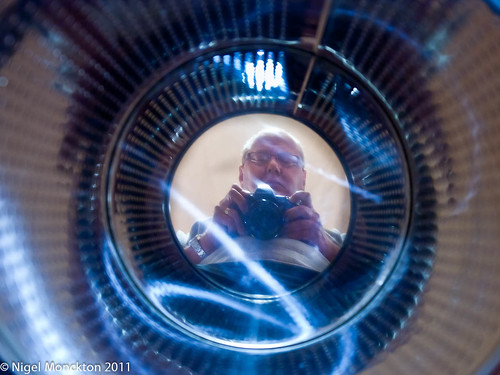
Shooting details are: f/4;1/6sec (2/3 stop underexposed); ISO 400; 29mm (58mm FOV equivalent). The lighting is low wattage domestic fluorescent (energy saving bulb) and the reflection is in the base of a chromed steel laundry bin constructed a little like a washing machine drum. I braced the camera strap taught against my neck and relied on that and IS to achieve a sharp image – I focussed on my face in the reflection.
It is difficult to claim that this shot provides much insight directly although it does point to my occasional eccentricity. I like the interplay of the reflections, the blue flashes (caused by adjusting the colour balance to achieve reasonable skin tone and playing with the sliders for the blue channel) and the overall weirdness of the shot. It reminds me of an early ‘70s Dr Who special effect.
I was surprised to find that a colleague that I showed the shot felt that it summed me up very well – I was holding my camera and the shot was a little weird!
The last shot takes playing with my portrait even further.
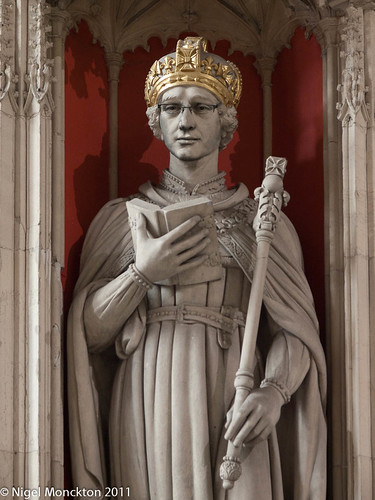
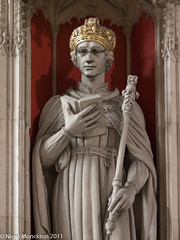
The shooting details for the statue are: ambient light in York Minster; f/4.5; 1/20sec; ISO 800; 54mm (108mm FOV equivalent). the face was taken from an unused shot in the series that produced my third shot, above. Using Photoshop Elements I copied the face, pasted it into a layer in the statue image, then flipped, rotated and distorted it to fit roughly the eye and mouth locations on the statue. I converted it to black and white and then blended it using ‘multiply’ finally I tidied the image by some levels adjustment in the face layer, and some cloning to more effectively blend the glasses and the chin line.
The blend is not perfect – there is a little too much contrast in the face because my PS skills are not quite there yet, but this would probably improve with practise, and perhaps by shooting a self portrait in the same lighting as used for the statue.
Unsurprisingly, given that I am an archbishop, the pose is quite formal and serene, with the props providing plenty of clues to my ’occupation’. The other thing that has happened is that the structural detail revealed by the lighting of the statue has imposed itself on my face so that my identity is quite heavily disguised. My daughter claimed to be able to recognise me, but my wife couldn’t. Maybe there is a metaphor tucked away there somewhere as my identity is subsumed into that of another person.
An alternative technique to a similar end is to take a full portrait and blend it with a stone texture layer. I didn’t try this as I was keen to see the effect of converting myself to an ex-archbishop. The technique probably bears some comparison with the tableaux photography of the early years of photography, where people played out scenes in costume, and perhaps even more crudely the ‘head-through-hole-in-a-backdrop’ type photos that still occur in some fairgrounds.
This has the potential to be the first of a series – I shall be keeping an eye open for interesting statuary. As an idea I can see some parallels with Cindy Sherman’s movie stills series.
Overall thoughts
The first thing that strikes me about this set is that there is no outdoor photography. I did try a couple of takes of myself involved in gardening,but was not particularly happy with the results – I never seemed able to find the right lighting conditions when I had time available for photography. There are opportunities later in the course to address this, and I will also be using my photo-a-day blog.
The next issue is that most of the interior shots are taken with simple on-camera flash bounced from the ceiling. I believe I have produced some variety from that set-up, but this is an area I would like to develop in the coming months as the opportunities present themselves. The Strobist website offers a range of useful ideas to help me develop this area of my work.
The final area for improvement is to develop my understanding of portraiture in general. As noted above, I’m unconvinced about the ability of a photo to genuinely reveal character, and this is something I would hope to explore further in this and future courses.