Showing posts with label PnPExercise16. Show all posts

Sunday, 22 January 2012

Assignment 3 – another idea bites the dust

One of the potential sites I identified for Assignment 4 was a shot or two of the church at Newton Arlosh, but that has become redundant as I’ve re-thought the assignment.

However the church itself is historically interesting, being fortified to help protect villages against Border raiders. It has extremely thick walls, crenellations, arrow slit windows and a door that is only wide enough to admit one person at a time. It also has a defensively designed tower. To me all these things add up to a good reason to take some photos – which I duly did – thinking that they would make a good study for Assignment 3. Sadly, the more I think about it the more I have to admit it isn’t going to work either.

To start with, it’s a church. I know the assignment says I can choose whether or not to include people, but the fundamental purpose of a church is to allow people to come together to praise God. I’m sure that with good use of light it is possible to catch the idea of praise or divinity, but it wont capture a congregation – and the bottom line is I’m not personally prepared to interfere with a religious ceremony in order to capture a group of people at prayer – as I would inevitably have to do in a church this small.

The assignment also says ‘describe…the way in which (the space) is used’. Even if I stretch it to ‘was used’ I still can’t effectively show people hiding in the tower and defending their families and livestock. I can show defensive features of the church, but without the people I don’t see how I can provide sufficient context for the idea to hold together. Maybe I’m getting hung up on wording, but there are plenty of other building to work on for the assignment, so I’m going to post some images here to show the key points of the building as another project for Exercise 16: Exploring Function.

First up a couple of exterior shots to set the scene and show the crenellations, and the relatively small scale of the doorway and general absence of windows:

Newton Arlosh church (i)  Newton Arlosh church (ii)

These clearly establish the unusual design, and are more suggestive of a castle than a church. The next three are really about trying to capture the thickness of the walls, the confining nature of the entrance way and the military appearance of the windows.

   Newton Arlosh church (iii)  Newton Arlosh church (v)  Newton Arlosh church (iv)

And there it is. I’m finding this ‘sticking to the brief’ quite tricky but I’ll get there in the end. I have a few more ideas up my sleeve yet.

Sunday, 11 September 2011

PnP Exercise 16: Exploring Function (ii)

Junfraujoch is a railway station/tourist attraction high up in the Alps between Monch and Jungfrau. Much of it is built inside the mountain, and it seemed to offer a number of opportunities for exploring the function of man-made structures.I considered using the railway station itself, but this felt a little ordinary – it’s location underground having little influence on its function. Similarly the various exhibitions and the ice sculpture display did not really seem to me to offer anything that I could not have found elsewhere.

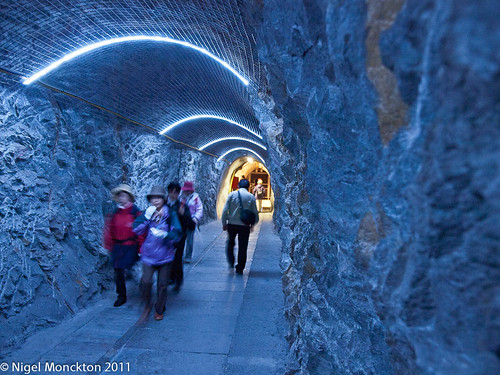
The essence of the construction for me, apart from it’s height in the Alps, is the fact that most of it is underground and largely intended to move tourists from the station onto the mountains – which lead me to the idea of trying to capture a tunnel and the purpose of a tunnel.

Tunnel, Jungfraujoch

I like this composition for a number of reasons:

  • there is, quite literally, light at the end of the tunnel which leads your eye in the direction of travel
  • the converging lines on the floor and the diminishing scale of the blue lighting also lead your eye through the tunnel
  • I considered cropping the mass of rock on the right, but left it in because I feel it gives a sense of the solidity of the surroundings.
  • there is enough blur in the people to provide a sense of movement. Perhaps a little more blur in the people would have conveyed a greater sense of movement – but I would have had problems getting  the rest acceptably sharp given I was already hand-holding at 1/6:f/2.8:ISO1600.

Final thoughts

Initially I started this exercise intending to capture the function of the Junfraujoch complex, but I felt this was too much to ask of one shot. Instead I opted for a simpler approach – capturing the function of one part of it. In this way this pass at the exercise was perhaps easier than castle Unspunnen – but on the other hand I had considerably less photographic material to work with. Overall I’m satisfied with the shot.

The exercise itself has emphasised the importance of having an idea of what you want to capture and why before you press the shutter. Sometimes this will be obvious, sometimes it will take more thought, but in the two cases of posted here I’ve taken shots I would probably not have considered without that discipline.

Finally I think the comparison of this tunnel shot with the Castle Unspunnen shot shows the value of including people when demonstrating function. While the castle shot clearly gives an impression of strength and some impression of a dominant position, the reasons for those attributes is not clear whereas the actual purpose of the tunnel is much more obvious. A little of this may be due to the relatively simplicity of the concept for the tunnel but overall I hink the epople are the key difference.

Wednesday, 7 September 2011

PnP Exercise 16: Exploring Function

This is the one exercise from this section I’ve yet to try – largely I think because I’m fairly spontaneous when it comes to photos and this one requires planning. Took a whole sheaf of photos while on holiday to illustrate this exercise but in truth most of them missed what, to me, seems like the point of the exercise – the pre-planning.

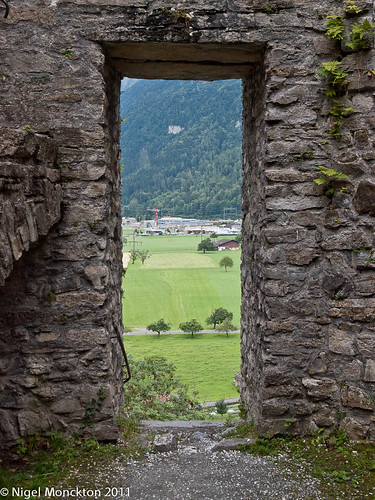
Happily there are a couple of exceptions – first up being this shot of Unspunnen Castle, near Interlaken.

Schloss Unspunnen, Interlaken

Although I know little about the formal history of this castle I had visited it before so knew what to expect. I also have some background knowledge on castles and their purpose.

This particular sample is situated on a hill overlooking the flat land around Interlaken – i.e. it is intended to dominate, provide a convenient military outlook post and by dint of its construction and site be hard to attack.

An ideal shot would show the strength of construction, emphasise its dominant position and give some idea of its separation from its surroundings. Initially I looked for an example of a crenulated wall, but there were none that offered an opportunity to demonstrate other aspects of the site – not least because there were some quite large trees around the site that were presumably not there when the castle was built.

This doorway seemed the best opportunity – it is clearly of very heavy construction and the view through the door is both far-reaching and indicates the elevated position. While there is relatively little context I think most people would recognise this as a castle – or a castle ruin.

Second example will be in my next post.