Showing posts with label PnPExercise08. Show all posts

Tuesday, 19 June 2012

Loose ends (iii): Just sitting

Another loose end from my list is that on reviewing this blog I found I hadn’t completed Exercise 8:Varying Pose. Continuing with the rather literal and un-creative self-portrait theme I adopted some 18 months ago feels a little like a tick box exercise at this stage, so I felt it would be more instructive to consider some photos I took during the course of this module in the light of my current understanding of the exercise.

I’m going to start with this pair of photos – taken 20 seconds apart – in York during the early stages of the module.

P4105338.jpg  P4105339.jpg

I especially like this pair because they show that relatively small changes in a pose can reveal quite different things. In the first the woman is clearly talking. From the upright posture of her head and the position of her arm it seems likely that she is being quite animated – yet by the simple expedient of leaning slightly forward, moving her arm to her neck and tilting her head to one side she becomes an attentive listener in the second shot (about 20 secs later). This variation in interpretation is achieved without any recourse to her eyes – which remain hidden in both – and is a good example of the power of pose to affect our reaction to a portrait.

This next shot is another example of the importance of head position in interpreting a sitting pose. This pianist, with his arms forward on his instrument and his head tilted to look at the keys is very clearly concentrating on his music and appears oblivious to the little girl watching at the end of his piano. A more raised head position would have suggested a greater awareness of his surroundings, perhaps even suggesting that he was not actually playing at the time of the shot – unlike in this version.

P4105368.jpg

This final shot is of a group of people sitting listening to a brass band concert and I include it here for the variety of seated poses and their impact on our view of the individuals pictured.

E5070303.jpg

The two gentlemen in the centre are sitting in very formal poses, and seem to be taking listening quite seriously – particularly the one on the left who appears to be craning his neck slightly. By contrast the three people on the left hand seat are very clearly relaxed as indicated by the more slouched position and their leg positions as well – indeed the only way the gent on the far left could appear more relaxed would be by putting his hands behind his head. In another take on a simple sitting position the girl on the right is quite upright, but the twist in her body suggests that she is really paying attention to the child in the buggy rather than the band. So, in one shot, in which the subjects are all in essentially the same pose, the slight nuances in limb and body position provide a whole range of clues about activity and intent which we are free to interpret on the basis of our experience.

It is only a short step from here to deliberately using this sort of variation to allow interpretations of a more formal portrait sitting.

Saturday, 2 April 2011

PnP Exercise 8: Varying Pose (ii) Lying on a bed

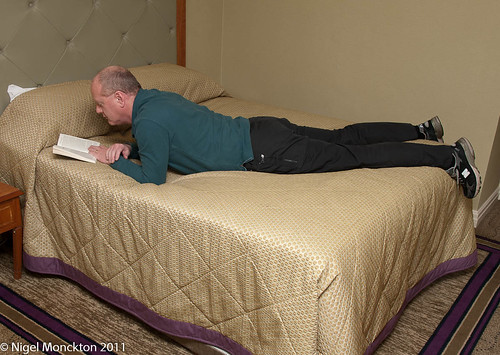
As with part (i) I’m the subject for this exercise – all the shots were in a single sitting, and I used a book as a prop because lying on a bed staring at the pillow looked unnatural. As before all shots were taken with bounced on-camera flash.

The first three variations of the basic pose are here:

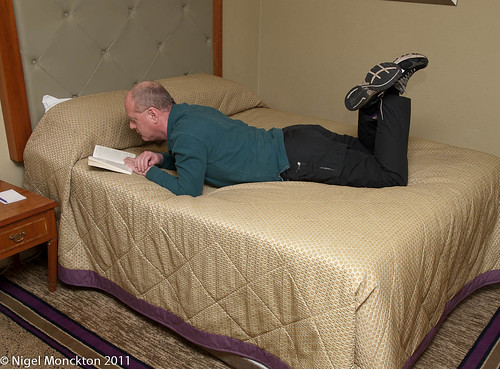
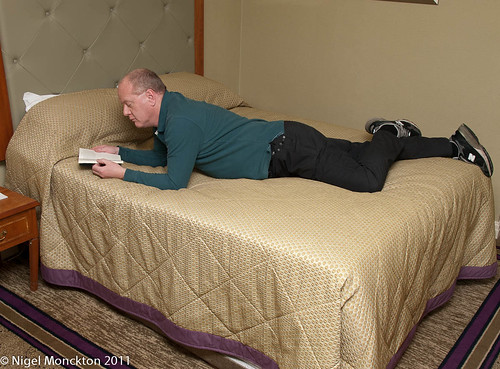
Face down, reading  Face down, legs curled Reading, legs crossed

The first pose looks reasonably natural, and is one I sometimes adopt when reading in hotel rooms, whereas the second looks, to me at least, a little odd from the angle used. It also felt a little uncomfortable, although it is quite a common pose in magazines to indicate relaxation, where it is more sometimes used head-on with just the feet showing above the head.

The third pose is perhaps the most natural looking. The crossed legs look less ‘arranged’ than the first shot, and the higher body position appears more natural for reading.

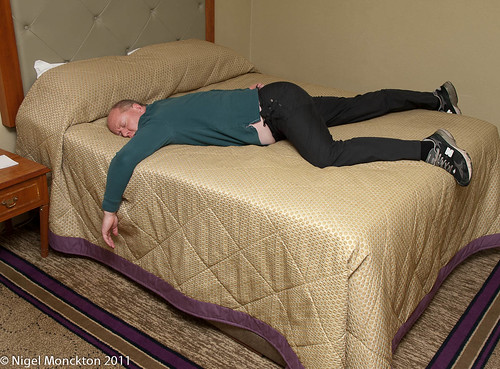
A quite different impression is given if the book is removed and the head is also lying on the bed.

Drunk and Disorderly

The dishevelled clothing, the limp arm over the side of the bed and the splayed legs clearly convey exhaustion or, less flatteringly, drunkenness. This is another classic example of how a photo can be used to communicate an agenda, or convey a message different from reality. If this were the only shot someone had of me it is likely they would reach a different conclusion about me than if the following were the only shot they had.

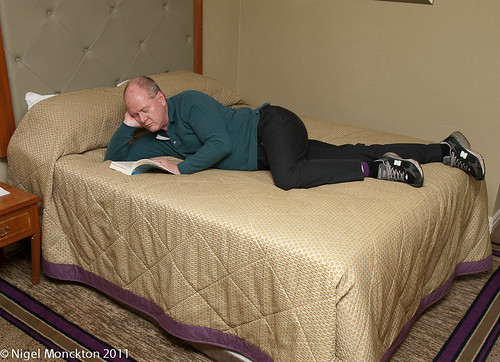
Reading, half-twisted

This is by far the most natural looking and most pleasing shot of this series. The slight rotation to half lying on my side and the head propped on one elbow is clearly comfortable, and I am ‘clearly’ engrossed in the book.

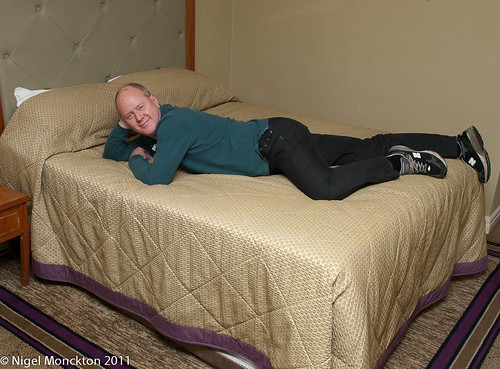
All of the above shots lack eye contact, which makes them appear – given that this is clearly a private room – somewhat voyeuristic. Eye contact removes this sense at a stroke:

Relaxed

In this shot I a clearly aware of being photographed – perhaps even a willing participant. The absence of any other prop suggests that I may just have woken from a nap, but a similar sense of engagement with the photographer would have been achieved if the book had still been in place.

PnP Exercise 8: Varying Pose (i) Standing

For this exercise I have used myself as the subject, and chosen as my three basic positions lying on my front (on a bed), standing and sitting. I have also chosen settings with a minimum of props so that the changing effect is largely due to the change in pose. All shots were taken with the camera mounted at hip level on a tripod and fired by a remote control so that I was not constrained by the self-timer delay. Lighting in each case was flash bounced from the ceiling

Standing.

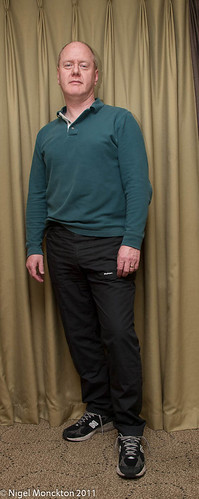
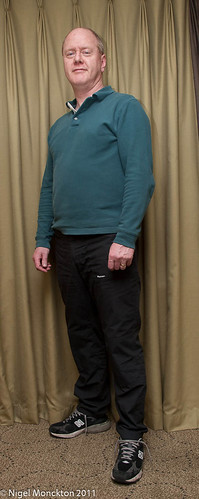
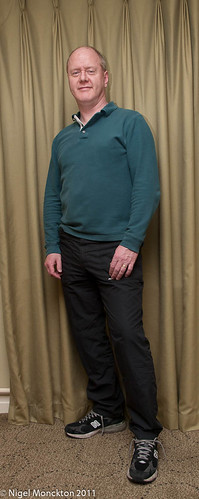
From left to right I transferred my weight from my front to my back foot. The only clear difference is where the weight is evenly balanced, because of the absence of a bent front knee. The bent knee pose looks very relaxed – which shows appearances can be deceptive because the weight on the rear leg pose is a fairly standard defensive stance in martial arts.

The middle stance feels quite unnatural but looks relaxed and alert.

Weight on front foot   Evenly balanced   Weight on back foot

The absence of any particular hand positions in these shots removes some of the visual clues as to the perceived state of the subject. So the next step was to keep the rear weight distribution but vary the hands.

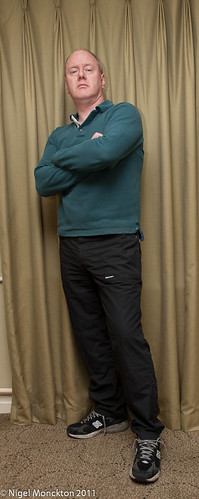
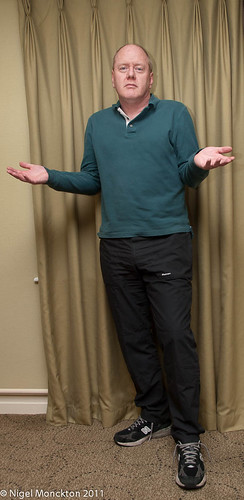
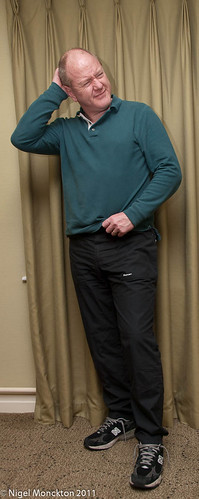
Back foot, arms crossed   Back foot, shrug   Back foot, puzzled

The left-most of these three is a very defensive stance. Typically it would signify an unwillingness to be involved or discomfort with a situation. The middle shot – a shrug – is a very open gesture. it suggests a lack of understanding, perhaps a willingness to compromise in an argument. In martial arts terms it is still a defensive  pose – the weight on the back leg frees the front foot for a kick at an advancing opponent, and the hands are in forward positions ready to deflect a blow. The final shot suggests puzzlement – particularly the scratching of the head and the furled brow. The arm across the body also suggests non-engagement while the puzzle is resolved.

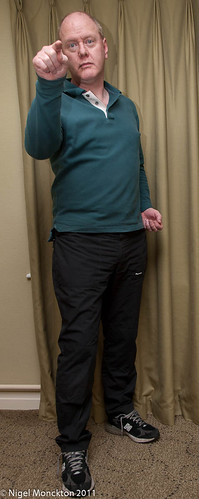
Finally moving to the front foot, hand position can be used to signify either aggression or friendliness. Note the front knee is still bent but the weight is much further forward than in the very first shot above.

Weight on front foot, confrontation    Handshake

The relatively low camera angle reduces the threatening nature of the first pose somewhat – it would be even more extreme if the lead finger was jabbing into the ‘face’ of the viewer. Note also that the back hand is forming into a fist – a subconscious reaction to the choice of pose which emphasises its threat. the final shot is an almost worldwide gesture of welcome or greeting, which despite the similarity in body position gives a completely different sense – almost entirely on the basis of hand shape.

In terms of attractiveness, the second and third shots are the most effective with a relaxed subject in an easy pose. I suspect very few people would welcome a portrait session with any of the other poses as the primary output.